Month End Offer : Get 30% OFF + $999 Study Material FREE - SCHEDULE CALL

sddsfsf

Pattern Exploration and Application in Data Mining: Unlocking Insights for Better Decision Making


Data mining is an essential procedure that allows using information from enterprise data. Data mining aids in creating a comprehensive perspective of the data and discovering patterns in the data to gain insights. Pattern finding in data helps discover hidden information that would otherwise be difficult to learn using traditional data mining approaches. The science of determining perceptual data using methods from statistics, probability, computational geometry, machine learning, signal processing, and algorithm design is known as pattern recognition. For an in-depth understanding of pattern exploration, our Data scientist course online helps you explore more about pattern exploration and applications in data mining, the most effective data science tool.

What is Pattern Exploration in Data Mining?

A pattern repeats itself in response to a set of conditions or regulations. Identifying patterns leads to essential data, simplifies decision-making, and simplifies our tasks. Various parallel missions, such as data management, preprocessing, data warehousing, pipelining, and loading of data for a specific purpose, the creation of machine learning, artificial intelligence models, analysis of the data using these models and existing statistical methods, pattern discovery, and pattern analysis, and finally displaying the facts uncovered, etc., are carried out under the hood of data mining.

Difference Between Data Exploration And Data Mining

Ironically, two primary techniques are mainly used to recover relevant data from gigantic, messy pools. They are known as manual and automatic methods. The main difference between data exploration and data mining is that the manual process is another term for data exploration, while the automated process is known as data mining. Now, Let's study both approaches in detail and compare their differences.

What is Data Exploration? 

Data exploration is the initial stage in data analysis. Data analysts utilize data visualization and statistical methods to describe dataset descriptions, such as size, quantity, and accuracy, to understand the data's nature better. Data analysts must first apprehend and create a comprehensive idea of the data before extracting relevant data for additional analysis. Data exploration strategies include manual analysis and automated data exploration software explanations. 

Importance of Data Exploration 

It's a well-known fact that humans process visual data more than numerical data. Therefore, it is difficult for data scientists and analysts to give meaning to thousands of rows and columns of data attributes and convey that meaning without any visual elements.Therefore, performing the initial data exploration phase allows data analysts to understand better and visually recognize irregularities and relationships that might otherwise go hidden.

Use Cases of Data Exploration

Data Exploration has been widely operated in multiple industries benefiting different goals. Let us have a look at some use cases of data exploration: 

  • Lead Generation: Companies can extract data from manuals like Yelp, Crunchbase, and Yellowpages and develop leads for business expansion. 
  • Content & News Aggregation: Content aggregation websites can earn regular data feeds from numerous sources and keep their sites new and up-to-date.
  • Sentiment Research: After extracting the online reviews, comments, and feedback from social media websites like Instagram, Facebook, and Twitter, people can identify the underlying perspectives and understand how they perceive a brand, product, or phenomenon.

What is Data Mining? 

Data mining is an organized and straight method of specifying and finding hidden patterns and data throughout a large dataset. Moreover, it makes machine learning models that are further used in artificial intelligence (AI). Data mining tools can clean through the databases and recognize invisible patterns efficiently by automating the mining procedure. For businesses, data mining is often used to uncover patterns and connections in data to help make optimal business conclusions.

Importance of Data Mining

It is a procedure of capturing large sets of data to define the insights and ideas of the data. It helps to create intelligent market decisions, run objective campaigns, and make predictions. With the help of Data mining, it can study customer behavior and their insights. This results in great success and data-driven business.

Use Cases of Data Mining
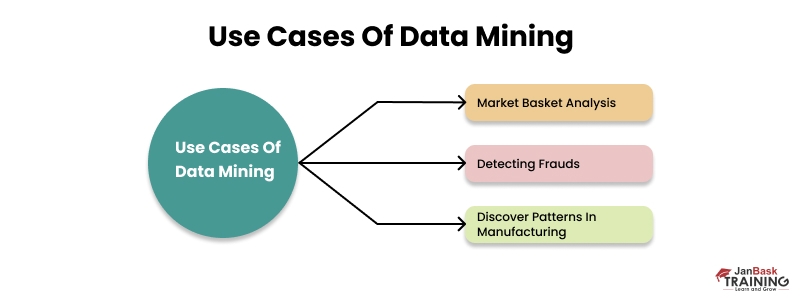
Data mining can help segment customers, detect scam activities, forecast sales, etc. Typical data mining uses include:

  • Market Basket Analysis: This is a technique based on the idea that you are likely to buy another group of products if you buy a particular group. One famous example is that when fathers purchase diapers for their infants, they buy beer together with the diapers.
  • Detecting Frauds: Data mining assists in structuring models to catch fraud. Organizing samples of fraudulent and non-fraudulent reports empowers businesses to identify suspicious dealings.
  • Discover Patterns in Manufacturing: In the manufacturing enterprise, data mining is used to support design systems by revealing the relationships between product architecture, portfolio, and customer needs. It can also indicate future product development time and costs.

Types of Data Exploration In Data Mining

We can categorize data exploration types and techniques into manual data exploration and automated data exploration:

Regarding manual data exploration approaches, businesses have a few different options. They can write scripts to analyze raw data using open-source tools built using Python or manual data exploration tools like Microsoft Excel or Google Sheets spreadsheets to examine data in its basic format and create simple charts and data visualizations to detect patterns and correlations between categorical variables. Manual data exploration techniques contain writing scripts to observe raw data or manually filtering data into spreadsheets. Automated data exploration devices, such as data visualization software, benefit scientists by easily monitoring data sources and extensively exploring otherwise massive datasets. Additionally, graphical data displays, such as bar charts and scatter plots, are helpful tools in visual data exploration.

Application of Pattern Exploration In Data Mining

The application pattern discovery in pattern exploration or mining has several uses, which are as follows:

  • Pattern mining is commonly used as preprocessing in a variety of data-intensive applications for the removal of noise and data cleaning. 
  • It can analyze microarray data with tens of thousands of dimensions. 
  • Pattern mining allows for uncovering hidden algorithms and clusters in data. 
  • Trees, graphs, subsequences, and networks have all been utilized in pattern mining to examine sequence or structure data. 
  • Researchers in software engineering use coherent consecutive or gapped subsequences in code execution as sequential patterns to help uncover software faults.

Role of Pattern Exploration In Decision-Making

In this digital age, patterns are everywhere. A pattern can be seen physically or quantitatively through algorithms, apart from the typical mathematical computations such as totals, correlations, variations, ratios, and derivatives. A pattern indicates some important details waiting to be extracted from the data. Among other facts, a pattern could represent a growing trend, a receding factor, the ups and downs of a specific action, seasonal changes, and so on. 

Pattern recognition attempts to replicate the neural network abilities of the human brain, which advances artificial intelligence. Pattern recognition is one of the four foundations of computer science. Many practical computer science problems require pattern recognition to be effective. Pattern recognition is the essence of wisdom because patterns embody structure and order, which aid in organizing and making our work more accessible. Identifying and comprehending patterns is a vital part of problem-solving and mathematical reasoning.

Pattern Exploration is Essential in Data Mining:

  • It finds and predicts even the most minor bits of hidden or untraceable data; it helps classify unseen data and provides good predictions using learning techniques.
  • It can recognize and identify objects from a variety of distances.
  • It can assist in developing realistic, actionable predictions based on previously unseen facts.
  • It can create a comprehensive knowledge of the data as a crucial fundament for effective and efficient data science efforts.
  • Because problems share patterns, we can apply the same problem-solving method everywhere the pattern exists, making them easier to tackle.

How Does Pattern Exploration In Data Mining Or Data Science Work? And Its Types

A pattern repeats itself in response to conditions or regulations. Associating the patterns leads to the required knowledge, makes decision-making more accessible, and simplifies our tasks. Here are some pattern examples that can be found in data mining:

  • Periodic Patterns: These patterns are repetitive after a given time has passed. This pattern is typical in time series data, biological sequences, spatiotemporal (having both time and spatial dimensions) data, and so on.
  • Associative Patterns: These are similar to bread and butter" or "knife and fork in that they are a co-occurring group of things that make more sense. The constituents of this pattern are mutually beneficial.
  • Abnormal Patterns: These patterns appear when the data shows an apparent break from normal behavior, when an unexpected pattern appears between expected pattern, and when its appearance is not periodic.
  • Patterns of Structure: such as pathfinding in graphs or cluster identification: As an example, low-cost homes are more common in the suburbs, but higher-cost apartments are more common downtown.
  • Chaos Patterns: These occur but have no defined time, space, or frequency characteristic.

Different Pattern Exploration In Data Mining

Pattern exploration in data mining and analysis is highly beneficial in the following areas:

  • Sentiment and Trend Analysis: Patterns in this area can provide insight into the sentiments or moods of your customers or investors. If the feeling is positive or negative, this could lead to an increase in demand and price. You can also discover patterns, such as if something is popular or becoming unpopular. This application is widely used in e-commerce, retail, investment banking, voting patterns, and other fields.
  • Image processing and computer vision: A computer is given human-like abilities to distinguish things by processing their external characteristics, orientations, and behaviors.
  • Bioinformatics: Massive and complicated biological datasets can be examined to learn about drug side effects, the onset of a pandemic, demographic shortfalls, the genetic foundation of diseases, or changes at the molecular or cellular level.
  • Forensic Analysis and DNA Sequencing: Recognizing someone's biological parents or identifying a suspect based on remnants of his hair/sputum/skin, etc.
  • Speech Recognition: This method recognizes information that has been said. The program focuses on a pattern recognition algorithm that identifies spoken text and converts it into ASCII letters displayed on the screen. This also lets us identify the speaker's identity.
  • Automation of Assistance and Support: Assisting people and providing better assistance through technology by automating unnecessary daily chores allows employees to focus more on the important ones, thereby increasing employee productivity.
  • Manufacturing: In this, 3-D images such as structured light, laser, stereo, and so on are used as input, and the objects may be recognized.
  • Character Recognition: Both letters and numbers are identified by this application. This process takes an optically scanned image as input and produces alphanumeric characters as output. Its primary application is automation and information management. It is also used in page readers, zip codes, registration plates, and other applications.
  • Fingerprint Identification: In this technique, the input image is obtained through fingerprint sensors, which allows us to identify the fingerprint owner by getting various fingerprint classes.
  • Industrial Automation: At this point, we deliver the intensity or range image of the product and identify whether it's broken or not.

cta10 icon

Data Science Training

  • Personalized Free Consultation
  • Access to Our Learning Management System
  • Access to Our Course Curriculum
  • Be a Part of Our Free Demo Class

Conclusion

Patterns help improve information knowledge and provide more meaning to data. In data mining, pattern exploration enhances the effectiveness and quality of insights. Pattern discovery in data mining is a five-step method that is thoroughly explored. To conclude, we explored pattern discovery in data mining in layman's terms and how to get the most out of it in your big data analytics business. Understanding pattern exploration in data mining begins with understanding data science; you can get an insight into the same through our data science training.   

Trending Courses

Gen AI icon

Gen AI

  • Introduction to Generative Models
  • Generative Adversarial Networks (GANs)
  • The Art and Science of Prompt Engineering
  • MLOps: Deploying Generative AI Models
Gen AI icon1

Upcoming Class

2 days 30 Jun 2026

Agentic AI icon

Agentic AI

  • Introduction to Agentic AI
  • Multi-Agent Setup with LangGraph Context Handling in Graphs
  • Performance Benchmarking Advanced Prompt Engineering for Agents
  • Agent Behavior Tuning Project and Mock Session
Agentic AI icon1

Upcoming Class

12 days 10 Jul 2026

AI in Automation Testing icon

AI in Automation Testing

  • Intro to AI & ML in Automation
  • Playwright + JS (JavaScript) + API Tesng
  • Automaon with Using ChatGPT & Playwright MCP server
  • GitHub Copilot, AI Tools & Interview preparation
AI in Automation Testing icon1

Upcoming Class

5 days 03 Jul 2026

Cyber Security icon

Cyber Security

  • Introduction to cybersecurity
  • Cryptography and Secure Communication 
  • Cloud Computing Architectural Framework
  • Security Architectures and Models
Cyber Security icon1

Upcoming Class

5 days 03 Jul 2026

Data Science icon

Data Science

  • Data Science Introduction
  • Hadoop and Spark Overview
  • Python & Intro to R Programming
  • Machine Learning
Data Science icon1

Upcoming Class

6 days 04 Jul 2026

QA icon

QA

  • Introduction and Software Testing
  • Software Test Life Cycle
  • Automation Testing and API Testing
  • Selenium framework development using Testing
QA icon1

Upcoming Class

4 days 02 Jul 2026

Salesforce Service Cloud icon

Salesforce Service Cloud

  • Industry Knowledge Introduction
  • Adoption and Maintenance
  • Interaction Channels Introduction
  • Integration and Data Management
Salesforce Service Cloud icon1

Upcoming Class

5 days 03 Jul 2026

AWS icon

AWS

  • AWS & Fundamentals of Linux
  • Amazon Simple Storage Service
  • Elastic Compute Cloud
  • Databases Overview & Amazon Route 53
AWS icon1

Upcoming Class

4 days 02 Jul 2026