

About this question
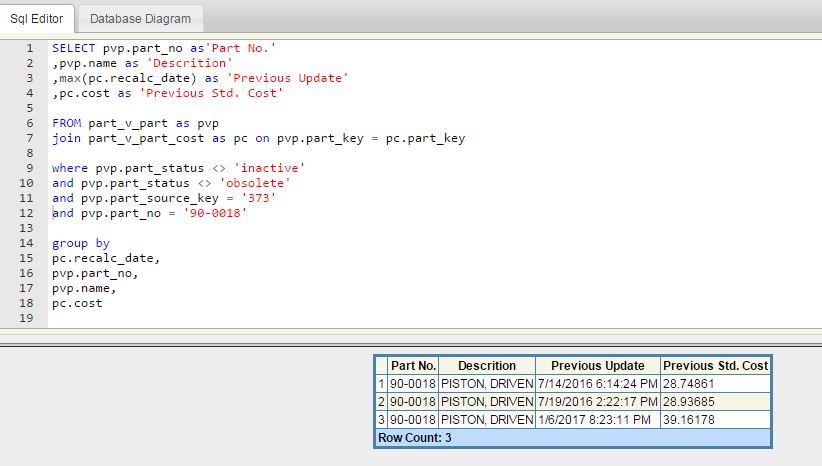
I have a simple query that I just want to return the most recent date for. I can't figure out why I can't do this:
How to find SQL server max date?
I have a simple query that I just want to return the most recent date for. I can't figure out why I can't do this:
How to find SQL server max date?
Log in to share your answer and help other learners.
Log in to answerBest Answer · By JanBask MS SQL Server Expert
Answered on Jul 19, 2021
I guess you don't quite understand how to use GROUP BY. A query with GROUP BY will identify the unique sets of values for the grouped-by columns, and then will allow you to use aggregate functions on any other rows in the data set. So, first you've said, give me the unique values for the four columns in your query.
I'll assume that, for each part # and description, you want the date of the most recent change in cost, and what that cost was.Without more information, it's difficult to give you a specific solution and guarantee it will work. We don't know what database you're using, not to mention what version of that database. Similarly, we don't know the data types and lengths of your columns. I believe the most generic answer would be a two-step process. First, identify the date of the most recent price change for each part; then, get the corresponding price. I'll be assuming your part numbers are up to 20 characters long, your description up to 250 characters long, and that the type of your pc.recalc_date column is datetime; replace with valid values for your system. That would look something like this (assuming you have access to temporary tables in
your language): CREATE TABLE #latest_price_change (part_no varchar(20), part_desc varchar(250), recalc_date datetime)
INSERT INTO #latest_price_change (part_no, part_desc, recalc_date) SELECT pvp.part_no, pvp.name, MAX(pc.recalc_date) FROM part_v_part as pvp JOIN part_v_part_cost as pc ON pvp.part_key = pc.part_key WHERE pvp.part_status <> 'inactive' AND pvp.part_status <> 'obsolete' AND pvp.part_source_key = '373' AND pvp.part_no = '90-0018' GROUP BY pvp.part_no, pvp.name SELECT lpc.part_no as 'Part No.', lpc.part_desc as 'Description', lpc.recalc_date as 'Previous Update', pc.cost as 'Previous Std. Cost' FROM #latest_price_change as lpc JOIN part_v_part as pvp ON lpc.part_no = pvp.part_no AND lpc.part_desc = pvp.name JOIN part_v_part_cost as pc ON pvp.part_key = pc.part_key AND lpc.recalc_date = pc.recalc_date
After setting up a part_v_part and a part_v_part_cost table that returned the same three lines as yours did when using your query, I just got back the last line with my query.
FYI - I tested this with MS SQL Server 2012.
Hope this helps.
Here is the syntax to find max and min date in SQL
Free tutorials and interview questions from industry experts — learn the skill, then get ready to prove it.
Step-by-step SQL Server guides from industry experts
Common SQL Server interview questions, answered
Guides, tips and career advice on SQL Server from JanBask experts.
 SQL Server Top 75 SSAS Interview Questions and Answers For Beginners & Experts
Prepare for your SSAS interview with our comprehensive guide featuring 75 top SQL Server Analysis Services interview questions…
 SQL Server How to Become a SQL Database Administrator?
How to become a sql database administrator In 2025, discover what these professionals do, explore how much they earn and learn…
 SQL Server OLAP vs OLTP: Key Differences, Architectures, Performance & Real-World Examples
Compare OLTP vs OLAP with clear definitions, architecture diagrams, real-world examples, and FAQs. Learn when to use each system…
 SQL Server 70+ Most Asked SSIS Interview Questions for Freshers & Experienced
Prepare for your next SQL Server Integration Services (SSIS) interview with our top 70+ SSIS interview questions and answers.…