
 JanBask Training
Introduction
In the era of technology defined by cloud computing & data science, features are evolving at the blinding speed of continuous deployment. One such evolution is SQL. As of the latest data, SQL is among the top 3 most popular database management systems (DBMS) in the world.
With data generated in enormous quantities, there is an ongoing need to process data in databases. Relational databases are among the most popular databases, and SQL is the basis for relational databases. That's why SQL skills are absolutely essential in most job roles.
This blog on SQL Commands will discuss the top commands and statements you need to understand in SQL. Much depends on the certification you hold, so give a jump start to your Cloud professional career by enrolling yourself in comprehensive SQL training online, today!
The Topics Covered In This Blog Are:
- What is SQL & its Features
- Top 4 SQL Commands with Examples(SQL DDL, DML, DCL, and TCL)
- SQL Skills in Demand
- The Future of SQL Databases
Let's Begin!
SQL Server Training & Certification
- Detailed Coverage
- Best-in-class Content
- Prepared by Industry leaders
- Latest Technology Covered

Why is SQL Critical?
SQL is the structured query language used to store, manipulate, and extract data in a database server. MySQL is a relational database management system. It supports large databases and can be customized.
SQL commands are instructions that are used to communicate with the database. It is used for carrying out specific tasks, jobs, and functions with data in the database. Therefore, SQL and Python/java are not competing. Python and Java have developed Excel in various areas, but both are versatile languages, whereas SQL operates from relational databases.

Features of SQL
SQL will help you to communicate with the database by commands. Here are some of the top features of SQL Database:
- It enables users to extract data from the relationship database.
- It enables users to set up databases and tables.
- It can be used to update, insert, delete and edit databases and tables.
- It provides security and allows you to specify permissions.
- Allows people to process information in new ways.
Also if you seriously want to become a SQL professional or pursue a career in a similar domain, then the first step is to consider enrolling in certified and industry-recognized Online Data Management Courses.
A Glimpse of SQL History
Her, are major landmarks from the SQL history:
- Dr. Edgar F. "Ted" Codd first introduced the relational model for databases in 1970.
- Structured Query Language first debuted in 1974.
- System/R was a product that IBM produced in 1978.
- A relational database prototype was created by IBM in 1986 and is now standardized by ANSI.
- 1989 saw the release of SQL's first version, and 1999 saw the release of SQL 3, which included features like triggers and object-orientation.
- Window features, SQL2003's support for XML, etc.
- Support for XML Query Language in SQL2006
- Improved support for temporal databases in SQL2011
Top 5 SQL Commands with Examples
To get a data job in 2025, you are going to need to learn SQL. As with any language and especially when you are a novice, it may be useful to have a list of common SQL commands in one place to refer to whenever you need it — we’d like to be that place for you!

So, below is a comprehensive list of SQL commands with examples:
Data Definition Language (DDL)
A data definition language (SQL DDL) is a computing language used to create and change the structure of database objects in a database. These database objects include tables, indexes, views, schemas, etc.
The SQL DDL is also known as the data description language in certain contexts because it describes fields and records in a database table. These commands are normally not used by a general user, who should be accessing the database via an application.So, let’s learn about SQL DDL commands with syntax.
Five types of DDL commands in SQL are:
- Create the database or its objects using the CREATE command (like table, index, function, views, store procedure, and triggers).
- Use the DROP command to remove objects from the database.
- ALTER: This is used to change the database's structure.
- TRUNCATE is one of the most important DDL commands in SQL, TRUNCATE eliminates all records from a table, as well as any spaces set aside for the records.
- COMMEND: This is employed to include comments in the data dictionary.
- If you are wondering how much does a SQL Developer make? The national average salary for a SQL Developer is $88,938 in the United States. Gain more insight on SQL developer salary here.
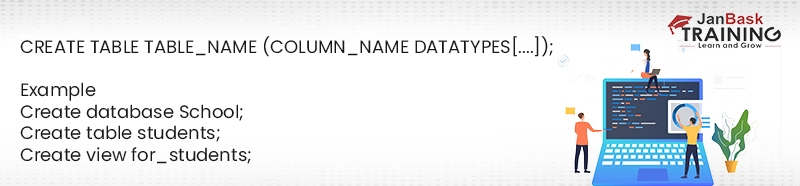
CREATE Command
It’s a DDL command used to create databases, tables, triggers, and other database objects
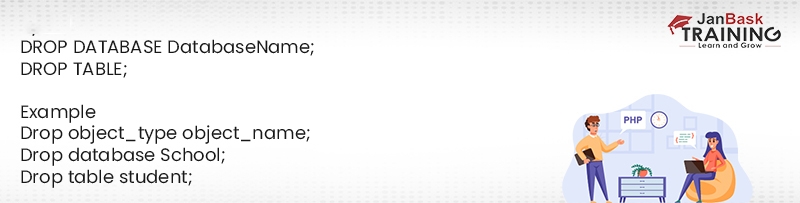
DROP Command
This DDL SQL command is used to delete objects such as a table, index, or view. A DROP statement cannot be canceled, so once an object is destroyed, it is impossible to get it back.
These are some of the top SQL commands that you have just learned. But, if you are seriously looking to increase your domain knowledge, check out this comprehensive SQL Career Path.
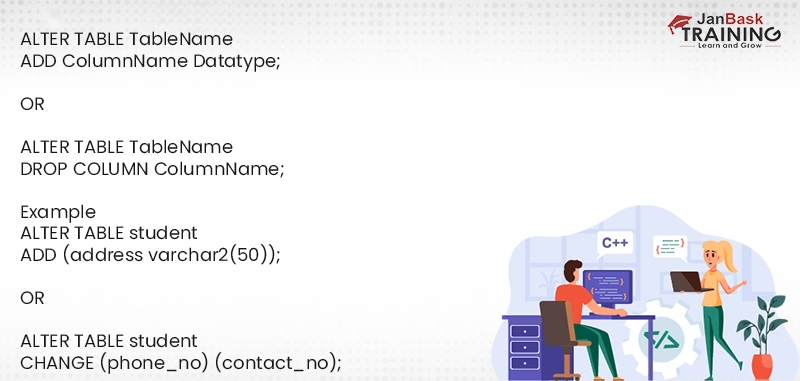
ALTER Command
ALTER is a DDL SQL command that changes or modifies the existing database structure and also modifies the schema of the database objects.
It is also possible to add and remove constraints from the table with the ALTER command.
TRUNCATE Command
TRUNCATE is another DDL command which deletes or removes all records in the table. This command also removes the space allotted to store table records.

RENAME Command
RENAME is a DDL command that is used to change the database table name.

Before moving ahead, evaluate your skills with this easy 2 mins SQL Quiz now!
Also, if you are looking to master the concepts and nuances of a variety of MSBI Interview Questions and Answers -all compiled in one place. Go through our guide and ace your preparation!
Data Manipulation Language (DML
The DML SQL commands change the data present in the SQL database. We can easily access, store, change, update and remove existing folders from the database using DML commands like SELECT INSERT INTO DELETE UPDATE. It is the component of the SQL statement that controls access to data and to the database. Basically, DCL statements are grouped with DML statements.
Here are some SQL commands that come under DML:
- Data are inserted into tables using INSERT.
- A table's existing data is updated using UPDATE.
- Delete records from a database table using the DELETE command.
- LOCK: Concurrency under table management.
- CALL: Call a Java or PL/SQL subprogram.
- EXPLAIN PLAN: It outlines the data access route.
Also, join our professional JanBask SQL Community to connect with industry experts and professionals.
SELECT Command
This DML instruction is used to select data from a database, and the returned data is stored in a result table, known as the result set.

INSERT INTO Command
INSERT is another major DML command in the SQL, which allows users to insert data into database tables.

DELETE Command
DELETE is a DML SQL command that enables users to delete one or more existing records in database tables. However, this command of Data Manipulation Language does not delete the stored data permanently from the database.

UPDATE Command
This DML SQL command is used to update or modify the value of a column in the table.

SQL is a big domain, hence if you don't want to limit your learnings. Then, learn the basics of SQL in our Comprehensive Guide on SQL.
Data Control Language
These SQL commands are used to grant and take back authority from any database user. In the database, this language does not have the feature of rollback. It is the simplest of three commands, which allows control access to information stored on a database and supplements DML and DDL SQL effectively.
Commands that come under DCL:
- GRANT: This command is used to provide users access privileges to the database.
- REVOKE: It helps withdraw the access privileges of users given by using the GRANT command.
Grant Command
This is one of the most important DCL commands that is used to give user access privileges to a database.

Revoke Command
Among the two DCL commands, revoke is useful in backing permissions from the user.

Also, if you are a beginner, looking to start your career in SQL. Check out how to become SQL Developer?
Transaction Control Language
TCL is one of the most used SQL commands. These commands are used to keep the database consistent and for transaction management made by the DML commands.
A transaction is a set of SQL queries carried out on data stored in DBMS. Each time a transaction is made these transactions happen temporarily in the database, to make the changes permanent, we use TCL commands.
The TCL Commands Are:
- COMMIT: Commits a Transaction.
- ROLLBACK: It is used to rollbacks a transaction if any error occurs.
- SAVEPOINT: It is used to set a save point within a transaction.
- SET TRANSACTION: This command specifies characteristics for the transaction.
Commit Command
This command is used to save all the transactions to the database. Each time we perform one of the DDL commands like -INSERT, DELETE or UPDATE, they may be canceled if the data is not stored permanently. So to be on the safer side COMMIT command is used.

SQL commands are not just limited to Business applications. It has a wide range of applications in the Data Science world. So, step ahead of your competition with Data Science Courses.
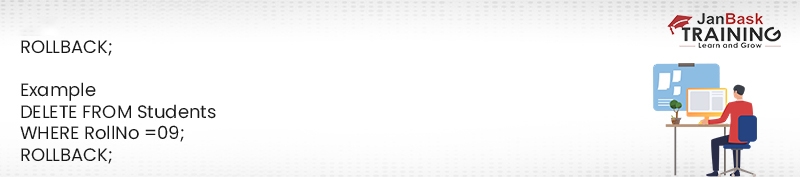
Rollback Command
This command is used to recover data or restore data to the last backup point or validated state. If for some reason the entered, deleted or updated data is not correct, you can return the data to a particular savepoint or if the savepoint is not done, then you can roll back to the last committed state.
SAVEPOINT Command
This command is used to store data at a particular point temporarily so that whenever necessary can be rolled back at that particular point.

Tip: Are you a fresher (intermediate or experienced) in RDBMS technologies? If yes, then you can check out our Top 100 RDBMS Interview questions and answers which can help you to crack your next RDBMS interview.
Data Query Language
Learn SQL Server in the Easiest Way
- Learn from the videos
- Learn anytime anywhere
- Pocket-friendly mode of learning
- Complimentary eBook available

DQL is one of the finest SQL commands that is used to fetch the data from the database. The goal of DQL commands is to obtain the schema relationship based on the request that is passed to it. While often referred to as part of DML, the SQL SELECT statement is strictly an example of DQL.
DQL uses only one command:
SELECT: It is used to retrieve data from the database.
It uses only one command:
-
SELECT
SELECT Command
This DQL command helps you to select the attribute based on the condition described by the WHERE clause.

Most In-demand SQL Skills
Most organizations are looking for professionals in SQL skills. Some of the SQL skills sought are:
- Database structures
- Creating a database with SQL
- MySQL and PostgreSQL
- Master PHP
- SQL statements and clauses
- SQL database management

Further if you are looking to accelerate your career in SQL. Enhance your career prospects by learning SQL from the scratch, and effectively managing and querying data. Also, don't forget to enroll yourself in exclusive programs designed by JanBask Training to boost your career & clear the above certification exams comprehensively.
What’s the Future of SQL & its Databases?
SQL is a massive technology. The future scope of being an SQL Developer is not just limited to Computer Science, but you can see it revolving around Retail, Finance, Healthcare, Science & Technology, Public Sector, in short everywhere.
Over the years, SQL has had a strong position on databases. SQL databases could be progressively phased out to more distributed models in the future, with NoSQL and Hadoop competing for first place.
According to Stack Overflow Developer’s survey, SQL is the second most commonly used programming language, used by 50% of all developers and beaten only by JavaScript – a language twice as old as SQL. Hence, SQL databases have a lot of scope in the future
If you are wondering how much does a SQL Developer make? The national average salary for a SQL Developer is $88,938 in the United States. Gain more insight on SQL developer salary here.
Conclusion
Understanding important SQL commands like DDL SQL, DML is essential to understanding databases on how to use and manipulate the dataset. SQL commands help us with a variety of functions that include writing, updating, editing, and deleting table data
Now that you are familiar with SQL commands, it is time for you to start querying and manipulating these updated and existing data sets. This is a critical step in moving forward on your journey to becoming a SQL expert. If you liked this article, and want to get certified, check out SQL Server Training & Certification program at JanBask Training and master all SQL server concepts in detail to use them in the workplace. Also, join our professional JanBask SQL Community to connect with industry experts and professionals.
If you have questions for us? Feel free to contact us or leave your queries in the comments section, and we’ll have our experts in the field answer them for you!
SQL Server Training & Certification
- Personalized Free Consultation
- Access to Our Learning Management System
- Access to Our Course Curriculum
- Be a Part of Our Free Demo Class


